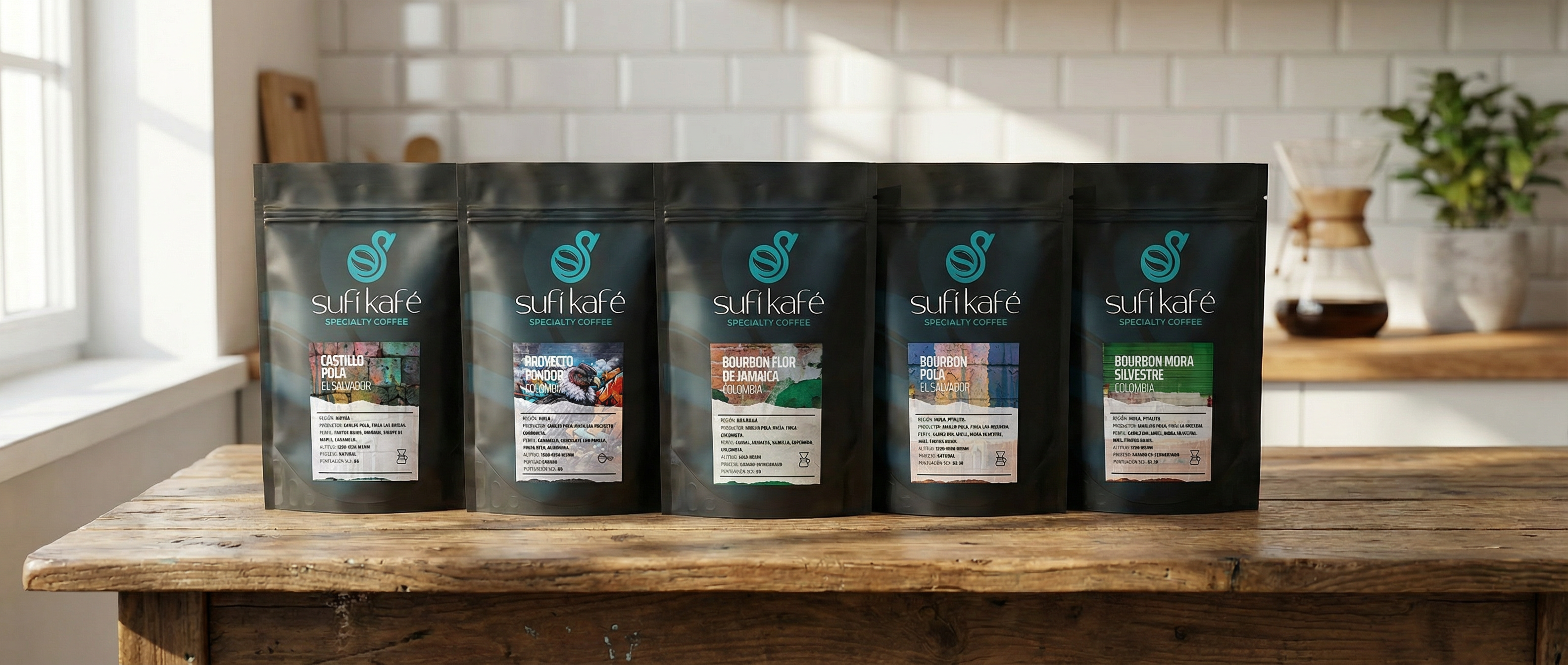
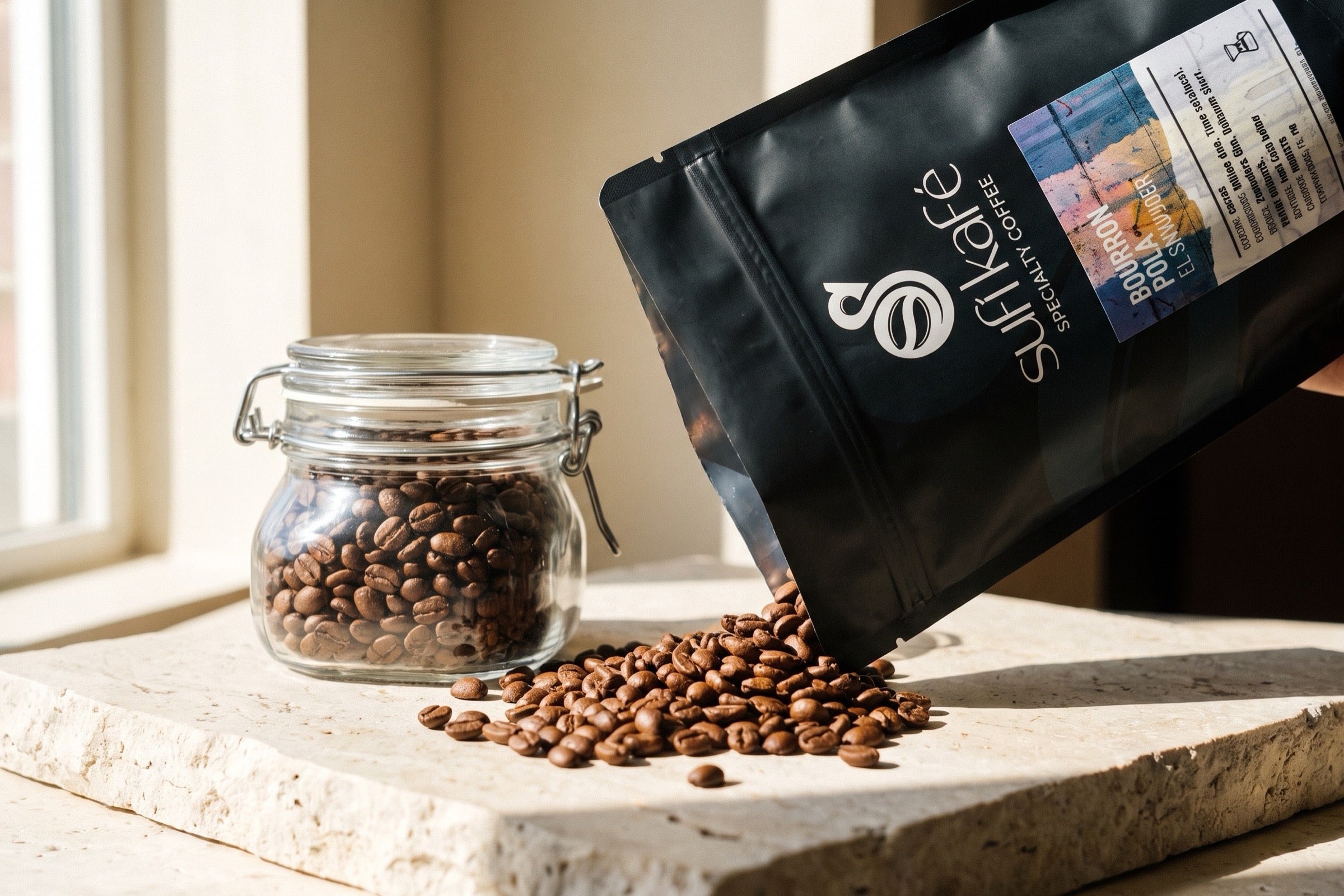
"What are the best coffee beans for espresso?" is the most repeated question in the trade. Almost every answer you'll find is a list of ten links. Ours is more awkward: there is no list. There's one set of criteria, and those criteria rule out nearly everything.
In short
- Espresso works at nine bars: it amplifies the flaw as much as the virtue.
- An espresso bean has to clear four filters. Most fall at the second.
- At the roastery we put every lot through those filters before deciding which profile it gets.
- Right now the Cóndor Project clears them, roasted for espresso. Our two Colombian omniroasts handle the machine too.
The four filters an espresso bean clears (or doesn't)
Before we talk about origin, farm or brand, a coffee has to get past this:
01
Bean density and hardness
At nine bars a soft bean compacts and channels. You need altitude — 1,500 m or more — for the seed to grow slowly and arrive dense. Without density there's no repeatability: the same recipe gives you two different cups.
02
Acidity that survives concentration
This is where most of them fall. A bright citric acidity that's beautiful in a V60 turns aggressive and sharp when you concentrate it ten times over. We're after malic acidity or ripe fruit, with structure — not acidity that hits and runs.
03
Body and solubility
Espresso is drunk in 30 ml. If the bean hasn't got enough sugars or body, the cup comes out short, watery and ends in bitterness. Controlled fermentation helps; heavily fermented naturals usually go too far.
04
A wide roast window
The filter nobody mentions. A coffee with a narrow window only works at one exact point of roast and rest: perfect today, a different coffee in five days. For espresso we want a bean that forgives, because nobody at home has a profiling machine.
A roaster offering you ten different espressos hasn't decided anything for you. They've just handed the decision to the customer.
Why a few and not ten
Roasting for espresso and roasting for filter are two different crafts on the same bean. The filter profile goes for clarity and aroma: short development, low drop temperature. The espresso profile goes for solubility and balance: more development time, more caramelised sugars, less sharp acidity.
Keeping ten espresso profiles alive at once means roasting them rarely, rotating them badly and selling you coffee degassing in a warehouse. We'd rather keep a few profiles, roasted every Monday and Thursday, and have you know exactly what you're buying.
Proyecto Cóndor: why this one
Southern Huila, Colombia. A blend of Colombia, Caturra and Castillo grown at 1,800 masl by 96 women coffee farmers of the Cóndor Project. Washed, with 24-36 hours of fermentation and 15-20 days of sun drying. It's the coffee we roast on a dedicated espresso profile.
OriginSouthern HuilaColombia
Altitude1,800 mdense bean, slow ripening
ProcessWashed24-36 h fermentation, sun-dried
In the cupVanilla · caramel · orangesoft citrus, long sweetness
It clears all four filters: the density that comes with altitude, a soft citrus acidity that doesn't break when concentrated, sugars for real body, and a roast window wide enough that it comes out right on a home machine and not only on a professional bar.

Roasted for espresso
Proyecto Cóndor · Huila
250 g, whole bean. Roasted every Monday and Thursday.
€16.50 · Buy
What about the omniroasts?
Wild Blackberry Bourbon and Pink Bourbon Jamaica Flower, both from Huila, are roasted on an omniroast profile: the same roast works in the machine and in the filter. As espresso they give a fruitier, brighter cup than the Cóndor — blackberry and raspberry in the first, hibiscus and pomegranate in the second. Straight, without milk, they're worth trying; with milk, go for the Cóndor.
How to tell whether your espresso is right
Three reference points that work on any machine, with no instruments:
01
Ratio
18 g in, 36–40 g out. If you need to go well past that for it to taste of anything, the bean isn't giving you body.
02
Time
25–30 seconds from the moment the pump starts. Faster: grind finer. Slower: grind coarser. In that order, without touching anything else.
03
Rest after roasting
Between 7 and 21 days from the roast. Before day 7 the CO₂ wrecks your extraction; after day 30 you lose the aromatics. That's why the roast date is printed on the bag — we go into it in
the art of roasting.
Quick questions
Can I use a filter coffee for espresso?
A coffee roasted for filter usually comes out sour and short at nine bars; it works better in an Aeropress or a well-handled moka pot. That's what the omniroasts are for: one roast built to work in the machine and in the filter.
Do you sell ground coffee for espresso?
No. Whole bean only. The grind for espresso has to be exact for your machine and it oxidises in minutes; shipping it ground would mean selling a worse coffee than the one we roast.
Does it work in a moka pot or a refillable capsule?
In a moka pot, yes, and very well: take the grind one step coarser. In a refillable capsule it works too, though the extraction is harder to control.
How often do you roast it?
Every Monday and Thursday. The bag carries the roast date, not a generic best-before.